Note: This was written in class as a response to this video. I thought it was worthwhile to post here.
“Good” and “bad,” firstly, are artificial constructs. The connotations of these concepts changes over time. In the late-1800s Bible Belt, “bad” behavior (i.e., behavior that would send you to hell) included “speaking with levity,” according to a religious tract I saw in a museum display. Today, a regular joke section in Reader’s Digest assures readers that “laughter is the best medicine.”
So it’s difficult to assign the label “good” or “bad” to face-recognition advertising. As far as the purpose of advertising is concerned, this innovation is beyond good: it’s something out of a fairy tale. Retailers can finally control how their advertising dollars are spent-- no longer hit-and-miss mass advertising, but promotions tailored to their audience. If only the target demographic is viewing a particular ad—we’ll use feminine products as an example—returns on investment increases substantially. The Tampax retailer is probably slavering over this idea: he only wants to reach the percentage of total audience who is female and who needs feminine products. If he can pay for advertising to just that target, which means not paying for the audience of males, children, and postmenopausal women, his return on investment goes up per viewer.
From the consumer’s side, this is also a good situation. Dad and the boys no longer have to be exposed to those awkward Tampax spots; instead, they can see ads for things that they might use: fishing equipment, sports cars, bigger and better TV sets. They are less likely to perceive these tailored ads as junk, and more likely to stop in the store.
This is most beneficial for a company like WalMart, which sells just about everything, or other general store or department store business models. They can really put this technology to use because their diverse array of products can literally appeal to any target group.
In the utilitarian sense, then, this technology is fantastic. It saves consumers the time of wading through irrelevant advertising; it saves companies considerable risk. What more can you ask for, as a business or as a consumer?
But it’s not about asking for; it’s about looking forward. The label of “bad” comes from an understandable uncertainty. The way we perceive advertising is in a state of change. The very definition of advertising-- the mass-appealing, static “dirty little secret” of an industrialized economy—is changing. That’s scary. It’s as scary as the information revolution caused by the Internet—an upheaval that is still making waves as we work to redefine the way we have understood information since writing was invented. As long as general consensus reflects the early-1900s attitude of the crassness and vulgarity of advertising, facial-recognition advertising will be perceived as “bad”—despite the multiplicity of benefits, in cash and consumer satisfaction, that it provides.
Is that satisfaction worth a perceived invasion of privacy? That question will be answered in the course of advertising’s own revolution, which has already begun. In all likelihood, I imagine facial-recognition advertising will become almost standard. It just makes too much sense—and when have questions of morals stopped anyone?
Tuesday, March 30, 2010

Monday, March 29, 2010
For Kristen
Sunday I made the trip to Bowling Green to attend my friend Kristen’s senior undergraduate flute recital. Since she is a talented musician and has a work ethic that puts Protestants to shame, it was a fantastic concert. This post, therefore, is dedicated, in honor of Kristen, to Menken and Schwartz.
…Okay, rewind. How did I go from flute recitals to Menken and Schwartz? (And who are Menken and Schwartz? We’ll get to that…)
The answer is fifteen years of friendship. Kristen is basically my sister. When we were little, our families traded babysitting—her mom would watch me and my brothers on Mondays, my mom would watch Kristen and her brothers on Fridays—so that our mothers (both of whom did the bookkeeping for their husband’s small businesses) would have a free day to work. And even though you didn’t need to know all that… well, it’s the human interest angle, right? Right.
Incidentally, Kristen’s mom was my piano teacher for twelve years. That may end up being important in the following anecdote (and if not, then just write it off as more human interest).
Pocahontas came out when I was approximately seven. Kristen and I LOVED (loved loved loved loved… etc) it, like most little girls our age. I had Pocahontas clip-on earrings; she had a Pocahontas Barbie doll; etc. Our most prized possession (I say “our,” but really it was Kristen’s), however, was a piano book of songs from Pocahontas. Too bad we were seven years old and could not even hope to play them.
By the time we were old enough to play the music, the book was long lost. If I saw the book today, I’m sure it would be “Easy Big Note Edition” or something that most people could play in their sleep. But at the time, it was the Eldorado of piano music. We wanted to play it SO BADLY…
Which brings us to Menken and Schwartz. Alan Menken and Stephen Schwartz are the reason that the Pocahontas song book even existed. They are the guys who came up with the music. And if you don’t know their names, I’ll bet you know their work.
Composer Alan Menken (born 1949, as per Wikipedia) has won eight Academy Awards, for films such as The Little Mermaid, Beauty and the Beast, Aladdin, Pocahontas (of course), and, more recently, Enchanted. In the wonderful world of musical theatre, his credits include music for the stage version of Beauty and the Beast and Little Shop of Horrors (which if you haven’t seen, you should. Here’s a link to the title song).
Composer and lyricist Stephen Schwartz (born 1948, again from Wikipedia) may or may not be my own personal hero. Lately, he is probably best known for the musical Wicked, an adaptation of Gregory Maguire’s book of the same name. Schwartz has three Grammys, three Academy Awards, and a has been nominated for six Tonys. (A joke for those of you who are casual 30 Rock viewers like I am: all he needs is an Emmy to win Tracy’s lusted-after EGOT.) In all seriousness, though: Stephen Schwartz writes sweet stuff. Other notable stage credits include Godspell and Pippin. Film credits include Godspell, Pocahontas, the Prince of Egypt, and Enchanted.
To end:
Go run the hidden pine trails of the forest. It’s nice outside.


Saturday, March 27, 2010
A dearth of entries
I began this blog with zeal—mostly because I was adjusting to a quarter with a substantially lower workload than I am accustomed. By the end of week three, I’ve gotten used to all the down time and have found ways to fill my afternoons—ways that, unfortunately, do not include blogging. Instead, they usually involve TV.
So anyways, I’m back. Today’s entry? Disposable diapers. Last night at a family get-together, somehow I wound up as part of a discussion of cloth and disposable diapers.
No one in my family is planning on having a kid anytime soon, but my grandma (out of nowhere) made a comment about cloth diapers costing about half as much as disposable diapers. This set my mom and my aunt to reminiscing about the “good old days” when they had babies in cloth diapers—and provided an overview of the issue for my recently-married cousin and me.
That brings us to this entry: the history of disposable diapers. Actually, this site kind of does my work for me. I recommend giving it a read. It’s pretty interesting.
Also according to the original article, diapers weren’t such a huge deal until the Industrial Revolution—until then, parents just kind of did whatever. But once they had enough money to buy furniture worth protecting, keeping your baby (and home) clean moved up on the priority list. Who would have guessed that sofas, rugs, and easy chairs were the real reason people became sanitary in the 19th century?
Diapers were named after the fabric out of which they were made. According to this Wikipedia article, “diaper was the term for a pattern of small repeated geometric shapes, and later came to describe a white cotton or linen fabric with this pattern.” This is an example of this kind of fabric, today called bird’s-eye linen. Traditionally, “diaper” refers to a diamond-patterned weave like this:

In the 1940s, diapers were rectangular pieces of cloth, and it took some special folding to diaper your kid—probably like this:

Interesting side note before closing: In the course of the family diaper discussion, my mom commented on how uncomfortable cloth diapers were for babies. My mom and aunt hypothesize that the reason kids potty train later now than they did twenty years ago is because disposable diapers are so comfortable—toddlers have no real incentive to start using the grown-up bathroom. It bears considering.
Wednesday, March 24, 2010
Saturday, March 20, 2010
Silhouettes

“Fashion is architecture: it is a matter of proportion.” –Coco Chanel
I’m not particularly preoccupied with keeping up with the latest styles; my goal when shopping is to see how little I can spend. I once bought a shirt for 58 cents. So far, that’s my record.
But avoiding high-ticket clothing items doesn’t mean that I don’t care about how I come across. First impressions are hard to change. And a big part of a first impression can be what you’re wearing. To me, “fashion” is all about presentation. And it’s not so much about keeping up with the Guccis as it is about dressing in a way that is becoming.
Guys, you probably don’t care about this. You can put on a pair of slacks and a button-down shirt and it looks sharp. For the most part, you’re shaped similarly. Women, on the other hand, have way more variables. We can’t buy pants based on waist, outsteam, and inseam; we’ve got inseam, outseam, waist, hips, rear end, thighs, calves, varying shoe height… I’m not complaining. I’m just saying: on some women, slacks and a button-down shirt are frumpy. It can take us a little more effort to get that professional, pulled-together look.
So, obviously, this post is not going to help you much if you’re a guy. But you can keep reading if you want. Don’t let me stop you.
Understanding how to flatter different silhouettes goes a long way toward dressing professionally. Silhouette is not about how thin or heavy you are; instead, it is about proportions. Does your waist naturally cinch in? Are your hips narrower than your bust? As this site says: “The most important thing to analyze first is the body shape we currently have: keep in mind that it has nothing to do with size, it's all about proportions. All body types come in a mix of fuller and slimmer shapes.”
There is no set number of body shapes; it varies depending on the source. Here are some visual classifications:
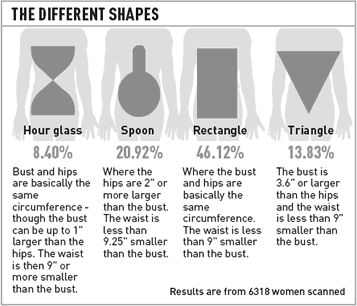

This site has a pretty comprehensive classification system with twelve body types. It also gives some ideas of styles that are flattering (or “solve problems”) for each silhouette.
While most sites have a stereotypical silhouette for each shape, this site offers celebrity examples for each shape—just going to prove that no one shape is necessarily more desirable than another.
This site and this site offer suggestions for evening gown and wedding gown styles based on body type. And to be honest, this is the main reason for this post: through a series of unusual circumstances, I will be attending a Navy ball in Connecticut this April, and am looking for a dress! The other reason is that I was a 4-H girl for ten years, and this is the kind of thing you learn in sewing projects.
Finally, fun fact of the day: the modern nomenclature for "one who sews" is "sewist." Seems like it should probably be "sewer," but that looks like the name for things that drain water and garbage off the street.
Friday, March 19, 2010
Agatha Christie
Tonight, I remembered just how awesome Agatha Christie is.
I’ve read some Agatha Christie in my day—not a lot, but enough to have a profound respect for her as a mystery writer—but somehow I always forget just how cool she is. Agatha Christie is her own Miss Marple: that quiet, proper, understated old maid who nonetheless sees right through veils of intrigue and deceit... and yet at the end of the day goes home to her tidy cottage and almost fades from everyone else’s memory.
The play “An Unexpected Guest” premiered tonight at the Van Wert Civic Theatre, an amateur theatre in my hometown (50 miles west on U.S. 30; if you hit Indiana, you’ve gone too far).
Although the acting quality wasn’t what I’ve grown accustomed to at Freed, VWCT is pretty darn good in the community theatre world. So it was time for me to sit back and let a little suspension of disbelief work its magic.
The setup of the play is this: A stranded motorist knocks on the French windows of a house and enters, looking for a telephone. Instead, he finds a man dead in his wheelchair—and the man’s wife, holding a gun, standing on the other side of the room. The woman says that she did it. The motorist, taking pity on her, proceeds to work with the wife to make the scene look as if a stranger broke into the house, shot the man, and left again.
As the story unfolds, it turns out that the wife wasn’t the killer… but who was? Nearly all of the occupants of the house—the man’s mother, the family secretary, the manservant, the retarded brother, and the wife’s secret lover—are under suspicion at some point in the play.
Somewhere in the middle of the show, I started to lose faith in Agatha. All the signs pointed to a particular character; it seemed as if it was that character; everyone else believed it was the character, he was essentially convicted… I thought to myself, this is like CSI/NCIS/Cold Case/Criminal Minds/insert crime drama here. I know whodunit. I’ve seen it all before.
And then it happened. The Agatha Christie ending. Almost every single character in the play was under suspicion except for one. And, like Agatha Christie herself, the character seemed to squeaky clean, too perfect, to unimportant to be the killer. But Agatha has a flair for the deliciously unexpected, and oh boy, she delivered.
The play itself was enhanced by a spectacular performance by the actor who portrayed the retarded brother; it was I am Sam set in an Agatha Christie mystery—and it was too perfect. The experience was enhanced by an audience full of old people who liked to make rude comments, sneeze, burp, and speak too loudly (likely because of hearing aids and whatnot). Oh boy, I’ve missed Van Wert…
Regardless, I encourage everyone to experience Agatha Christie at least once. Read a book, watch a play, check out Murder, She Wrote, listen to a book-on-tape (I have one, if you want to borrow). Whether you like genre fiction or not, reading a master is reading a master, no matter what the classification. And hoo boy, Agatha Christie is nothing if not a master of her craft.
Link to the official Agatha Christie site.
I’ve read some Agatha Christie in my day—not a lot, but enough to have a profound respect for her as a mystery writer—but somehow I always forget just how cool she is. Agatha Christie is her own Miss Marple: that quiet, proper, understated old maid who nonetheless sees right through veils of intrigue and deceit... and yet at the end of the day goes home to her tidy cottage and almost fades from everyone else’s memory.
The play “An Unexpected Guest” premiered tonight at the Van Wert Civic Theatre, an amateur theatre in my hometown (50 miles west on U.S. 30; if you hit Indiana, you’ve gone too far).
Although the acting quality wasn’t what I’ve grown accustomed to at Freed, VWCT is pretty darn good in the community theatre world. So it was time for me to sit back and let a little suspension of disbelief work its magic.
The setup of the play is this: A stranded motorist knocks on the French windows of a house and enters, looking for a telephone. Instead, he finds a man dead in his wheelchair—and the man’s wife, holding a gun, standing on the other side of the room. The woman says that she did it. The motorist, taking pity on her, proceeds to work with the wife to make the scene look as if a stranger broke into the house, shot the man, and left again.
As the story unfolds, it turns out that the wife wasn’t the killer… but who was? Nearly all of the occupants of the house—the man’s mother, the family secretary, the manservant, the retarded brother, and the wife’s secret lover—are under suspicion at some point in the play.
Somewhere in the middle of the show, I started to lose faith in Agatha. All the signs pointed to a particular character; it seemed as if it was that character; everyone else believed it was the character, he was essentially convicted… I thought to myself, this is like CSI/NCIS/Cold Case/Criminal Minds/insert crime drama here. I know whodunit. I’ve seen it all before.
And then it happened. The Agatha Christie ending. Almost every single character in the play was under suspicion except for one. And, like Agatha Christie herself, the character seemed to squeaky clean, too perfect, to unimportant to be the killer. But Agatha has a flair for the deliciously unexpected, and oh boy, she delivered.
The play itself was enhanced by a spectacular performance by the actor who portrayed the retarded brother; it was I am Sam set in an Agatha Christie mystery—and it was too perfect. The experience was enhanced by an audience full of old people who liked to make rude comments, sneeze, burp, and speak too loudly (likely because of hearing aids and whatnot). Oh boy, I’ve missed Van Wert…
Regardless, I encourage everyone to experience Agatha Christie at least once. Read a book, watch a play, check out Murder, She Wrote, listen to a book-on-tape (I have one, if you want to borrow). Whether you like genre fiction or not, reading a master is reading a master, no matter what the classification. And hoo boy, Agatha Christie is nothing if not a master of her craft.
Link to the official Agatha Christie site.
Thursday, March 18, 2010
NCLB, Part I
This entry is based on this New York Times editorial.
The way I see it? NCLB is addressing symptoms, not causes. And no matter what you call it (this Yahoo article says the name will change—good marketing move, Dems), only the foolish man builds his house upon the sand.
I’m not saying this is a hopeless cause. I think Obama is doing his best with what he has—he has NCLB, he has a problem, so he’s doing what he can to fix it. He’s repositioning the system’s priorities and its way of dealing justice. Okay. It’s a start.
But saying that “the quality of teachers assigned to schools with poor and minority children” is the real problem… sorry, bud, but I don’t think it’s so. Teachers aren’t priests. These guys are free agents, my friend. They apply for jobs where they want them—and if it was me, I would be looking for a job near a nice suburb, where I don’t have to put bars on my windows and where I can send my kid to the public school. If I have the resources and I can get hired, that’s where I’m headed.
And teachers are college-educated. Good teachers have the tools and skills to move to suburbia or get a job at a private school where kids are polite and want to learn. The problem is not that teachers are avoiding poor and minority students, per se; they are avoiding the environments in which many poor and minority students are found.
Maybe this is a hasty generalization. I grew up in small-town Ohio, after all. Ninety-nine percent of my entire county is white. The most intense thing that happened in Van Wert City Schools was a fake bomb threat in 2002. The entire ordeal lasted less than six hours. (I guess we also had a tornado. But that was probably not caused by students.) So what do I know about minority schools? Nothing, I guess. Just rumors. But my cousin went to public school in Indianapolis, and he got into some bad stuff. So rumors and family experience. Kind of.
In any event, that’s irrelevant. If you have a good teacher, he or she will want to teach bright children. If a school has bright students, it will attract better teachers. For good teachers, teaching bright students is their reward for hard work and skill in the classroom. This is the first flaw in the punishment/rewards idea. The reward is getting out of a school perceived in a negative light. No matter how much money you give that school, Obama, the teachers will still want to move to the system that has students who will do their homework and listen to lecture. Poorly-perceived schools will always have underqualified rookies. They are the ones who will take any job they can get their hands on to pay off student loans and to get a few years of teaching under their belts. But once those twentysomethings get married and start thinking about kids, they want to go where they can let their kids play outside and where they can feel safe.
That’s the real problem. It’s not about rewards and punishment—it’s about how things work. It’s not a problem that you can fix with a federal rewards/punishments program. It’s a social ill. I don’t know how you can fix that. (And in the history of civilization, no one, not even the Communists, have figured it out, either.)
I feel a little more confident in my ability to competently argue about curriculum. But since I’m out of time, maybe that will be NCLB, Part II.
In other news, check out this NY Times editorial. I like it.
Stripes and Solids
In honor of St. Patrick’s Day, I made my pilgrimage to the bar for green beer—and in the process, spent some time playing pool on a likewise green table. Hence, this post is dedicated to pool.
…But only the obscure stuff.
Specifically: baize.
Baize is that green fabric that hurts your elbows if you lean on a pool table wrong. (My grandma has a pool table, and that happened to me a lot as a kid. Mostly from crawling across the top of the table when the adults weren’t looking.)
According to dictionary.com, baize is “a soft, usually green, woolen or cotton fabric resembling felt, used chiefly for the tops of billiard tables.” In verb form, baize means “to line or cover with baize.” (Even though it’s in the dictionary as a verb, I’m unconvinced of its legitimacy.) Etymologically, it seem that baize is derived from “bay,” which is a reddish-brown color. Not exactly sure how we got to green from reddish-brown, but okay.
According to this definition, baize was first produced in England c. 1560, by French and Dutch refugees. It is a woolen (sometimes cotton) fabric napped to resemble felt. According to Wikipedia, the purpose of the coarse fabric is to slow the travel of objects, such as pool balls. The fabric is available in varying weights and thicknesses—the heavier the fabric, the greater the friction and the slower a ball will travel across its surface. Sleeker fabric, often “worsted” baize, offers less friction.
Besides pool tables, baize traditionally is used to line shelves, drawers, and card tables. It is also used to help soundproof doors: apparently, people used to tack baize to the door between the servants’ quarters in a home and the family’s rooms.
Fun fact: felt, which baize is meant to resemble, is the oldest textile known to mankind. It is made with felt, water, and agitation. (If you put a woolen sweater in the washing machine, you may end up with a felt sweater when it comes out!) In Central Asia, nomadic tribes use felt to create structures called “yurts”—basically, big felt tents.
…But only the obscure stuff.
Specifically: baize.
Baize is that green fabric that hurts your elbows if you lean on a pool table wrong. (My grandma has a pool table, and that happened to me a lot as a kid. Mostly from crawling across the top of the table when the adults weren’t looking.)
According to dictionary.com, baize is “a soft, usually green, woolen or cotton fabric resembling felt, used chiefly for the tops of billiard tables.” In verb form, baize means “to line or cover with baize.” (Even though it’s in the dictionary as a verb, I’m unconvinced of its legitimacy.) Etymologically, it seem that baize is derived from “bay,” which is a reddish-brown color. Not exactly sure how we got to green from reddish-brown, but okay.
According to this definition, baize was first produced in England c. 1560, by French and Dutch refugees. It is a woolen (sometimes cotton) fabric napped to resemble felt. According to Wikipedia, the purpose of the coarse fabric is to slow the travel of objects, such as pool balls. The fabric is available in varying weights and thicknesses—the heavier the fabric, the greater the friction and the slower a ball will travel across its surface. Sleeker fabric, often “worsted” baize, offers less friction.
Besides pool tables, baize traditionally is used to line shelves, drawers, and card tables. It is also used to help soundproof doors: apparently, people used to tack baize to the door between the servants’ quarters in a home and the family’s rooms.
Fun fact: felt, which baize is meant to resemble, is the oldest textile known to mankind. It is made with felt, water, and agitation. (If you put a woolen sweater in the washing machine, you may end up with a felt sweater when it comes out!) In Central Asia, nomadic tribes use felt to create structures called “yurts”—basically, big felt tents.
Monday, March 15, 2010
Mark it with a... what?
Happy belated pi day!

In honor of this auspicious mathematical observance, I baked an apple pie last night (exhibit 1, above) at about 9 p.m. By all accounts, I am a good pie baker—pretty impressive, considering that this was the first apple pie I had made solo. Usually my mom does the actual baking and I just stand around and eat extra dough (and get my fingers swatted).
But I guess something of the art rubbed off in spite of the stinging knuckles. Ironically, except for chocolate and sometimes apple, I don’t even like pie. But I do like to bake. So, pi(e) day was a good excuse to a) bake pie and b) get my roommate to try it. She’s really picky.
That’s all beside the point. The point is, I made some pretty good pie. And just like my mother taught me, I marked it with… well, I didn’t mark it with a “B” (pattycakes, anyone?) but I did mark it.
When my mom bakes pies, she always marks them the same way. It looks something like this: right parenthesis, left parenthesis, and two sets of three chicken scratches. (Or, just look at the crudely approximated Paint illustration to the right. That’s what it looks like.)
That pattern is the proud pie stamp of my mother, my mother’s mother, and my mother’s mother’s mother. Apparently back in the day, women had their own special pie signature. That way, you knew who brought what to the potluck. (Okay, that part is speculation. But I feel like it can’t be far off the mark.)
I think of them as pie signatures. I suppose that isn’t their “official” name, but some serious Google searching failed to yield any real results on the matter. My label is as good as any. The only direct reference I could find to pie signatures was here in a discussion thread. According to this woman, the marking was a regional indicator, not individual. Maybe Eddyville, Iowa, was less competitive than Johnstown, Ohio.
On this site, the section “The Pie as a Styled Centerpiece” gives an interesting history to the art of decorating piecrust. It focuses on the medieval/industrial evolution of the image of pie, which doesn’t exactly apply to a discussion of American farm lore, but is interesting nonetheless. In fact, the whole article is an interesting (and thorough) exploration of the history of pie. If you are ever looking for pie history, looks like this is the place you should go.
I was also told that yesterday was “the real man’s Valentine’s Day,” and, properly celebrated, involved steak. Sorry, guys-- I can make a mean pie, but steak isn’t really my thing. ….
Subscribe to:
Comments (Atom)
